The Ultimate Guide to Personal Energy Management
Mar 25, 2026
Why Everyone Feels Exhausted Right Now
Many people feel exhausted right now.
Not just physically tired... but mentally overloaded, emotionally drained, heavy, foggy, untrusting and uncertain.
When speaking to my friends, my colleagues and my clients, the phrase that keeps coming up is:
"I’m just tired."
And I feel it too.
Not the kind of tiredness that a good night’s sleep fixes.
A deeper kind of exhaustion; where thinking feels harder, emotions feel heavier, and even small decisions feel like too much.
If you are feeling this you are not alone.
Modern life places constant demands on our mental energy, emotional energy, and nervous system; often without giving us the recovery time we actually need.
In a world where we are constantly bombarded 24/7 with:
- constant notifications,
- Non stop flow of information
- AI Inception and what this means
- Political instability, and
- 100’s of daily micro-decisions
All the while trying to discern truth from lie, fact from fiction…. While still being parents, caregivers and throwing a bit of time in there for ‘self-care’.
It is no wonder our brain, bodies and nervous systems are screaming for reprieve.
The reality (and bad news) is that all of the above, keeps our autonomic nervous system under continuous pressure. Over time, this can lead to nervous system dysregulation, leaving us mentally exhausted and emotionally depleted.

The past few years I have really been questioning how the heck we can manage all this without going bonkers.
How can we as modern humans:
….who are embracing technology yet craving simplicity…
…living in a non-stop world, where systems are in place to keep us tired, drained and overwhelmed …
How can we learn to better tend to our emotional health in the moment.
Right now?
What I have realized is there is no right answer for everyone. I am still trying to figure it out. Some days I do great… others not so much….
However, for me, what is keeping me sane is having a better understanding of my personal energy, learning how to recognize dysregulation in my nervous system and taking micro-steps to daily to regulate.
In today’s article I am going to share a different way of viewing your energy and managing your wellness which you may find helpful as a tool in your holistic toolkit.
What Is Personal Energy?
We all know the feeling of energy - whether we totally understand it or not.
↠ The infectious laugh of a toddler.
↠ The greetings of a happy, socialized dog versus a dog who is frightened or scared.
↠ Those moments you walk into a room and you can cut the tension with a knife.
↠ When you are around someone that has an infectious energy that makes you feel joy, or on the other hand someone who literally feels like they are draining your soul of energy.
Or,
↠ when your physical energy is so low you struggle to get out of bed.
↠ When you are emotionally tanked…. And cannot handle one more thing.
These are unique and shared human experiences of feeling energy.
I understand personal energy through both a practical biological lens and a broader energetic lens. One helps explain how our internal systems function; the other helps me make sense of the subtle, lived experience of what we feel in ourselves and in others.
As an Helping Professional, Empath as well as aType A, left brain thinker; I need to understand Personal energy from the biological standpoint AND also from the ancient (and futuristic) point of view.
This is the lens I view personal energy from.
Personal energy is two fold.
- It can be viewed biologically as the functional capacity of the human system to think, feel, and act.
- In addition it is the unique personal energetic signals that we give off based on these biological reactions.
Therefore,
Personal Energy is the available capacity of your biological and psychological systems to think, feel, focus, and respond to the world. AND Personal Energy can be felt and measured through vibrations, frequencies and chemical reactions within our bodies creating unique personal energy signals.
The Three Dimensions of Personal Energy
So let's dive into the first part of personal energy from a mental, emotional and physiological view.
Mental Energy (focus and thinking)
Ever stare into your fridge wondering what the heck you are going to make for dinner?
Or struggle to concentrate and read the same line over and over again without retaining the information?
Or scroll Netflix for 30 minutes because you just cannot decide?
Mental energy refers to the brain’s capacity for attention, focus, and decision-making.
Psychologist John Sweller introduced Cognitive Load Theory, which demonstrates that the human brain has a limited capacity for processing information. When too many demands compete for attention, mental performance declines and tasks begin to feel significantly more exhausting.
In other words, our brains operate with limited bandwidth.
Just like an internet connection can only handle so much data at once, the human brain has a finite capacity for processing information, maintaining focus, and making decisions.
Unfortunately, in our modern world, many of us have too many demands competing for that bandwidth: emails, meetings, notifications, emotional conversations, and constant decision-making….
This drains our brains.
This is why long days filled with meetings, multitasking, and constant context switching can feel mentally exhausting.
Emotional Energy (what we carry and process)
Emotional energy can be thought of like a backpack we carry throughout the day.
Every interaction, difficult conversation, or emotionally charged moment adds a little more weight.
Listening to someone’s grief, managing conflict, or holding space for another person’s stress, reading the news, learning about traumatic world events all require emotional effort
Most of the time we don’t notice the weight while we are moving through the day. But by the evening, that backpack can feel very heavy.
Emotional energy reflects the psychological effort required to process emotions and navigate social interactions.
While we often talk about mental exhaustion and emotional exhaustion as separate experiences, these systems are deeply connected.
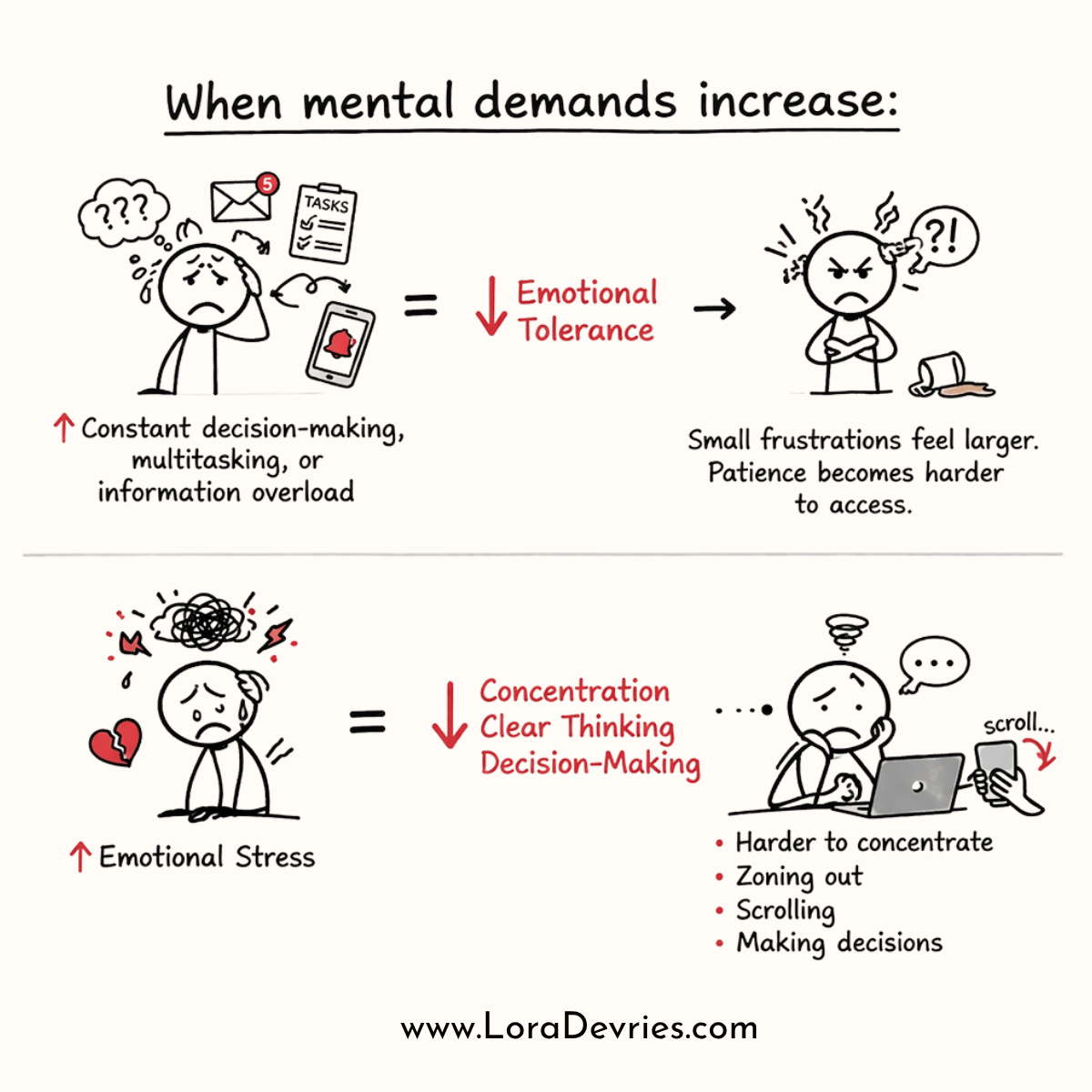
When mental demands increase:
↑ constant decision-making, multitasking, or information overload = ↓ emotional tolerance
Small frustrations feel larger. Patience becomes harder to access.
↑ emotional stress = ↓ concentration, clear thinking + making decisions.
Harder to concentrate, zoning out, scrolling, making a decision.
Beneath both of our physical and emotional energetic experiences sits another important system: the nervous system, which regulates how the body responds to stress and recovery.
Physiological Energy (how regulated or stressed our body feels)
Ever find yourself jumping at the slightest sound?
Having difficulty relaxing or resting, a sense of needing to stay busy.
Feeling detached from the body, zoned out, or "blank".
Frequent mood swings, yelling, or irritations at the smallest things?
Physiological energy refers to the body’s biological capacity to regulate stress and maintain balance.
Neuroscientist Stephen Porges has shown that the autonomic nervous system continuously evaluates cues of safety and threat in our environment. When our nervous system remains in prolonged stress activation, our bodies consume significant biological resources, contributing to fatigue and reduced cognitive capacity.
In today’s modern world, many of us are constantly living in our sympathetic nervous system - the one that is responsible for keeping us in fight, flight or fawn mode. Constantly being in this prolonged state of stress, often referred to as sympathetic activation, our bodies are consuming significant biological resources. Over time this can contribute to fatigue, irritability, difficulty concentrating and burnout.
Understanding how these systems interact is the foundation of personal energy management: the ability to notice, regulate, and restore the internal resources that allow us to function well.
Why the Nervous System Matters for Personal Energy
The nervous system plays a major role in how energized or depleted we feel throughout the day.
When the nervous system is in a balanced state, people often experience:
- clearer thinking
- greater emotional stability
- improved focus
- better recovery from stress
However, when the nervous system remains activated by ongoing stress for long periods of time, the body may begin to experience fatigue, irritability, difficulty concentrating, and emotional overwhelm.
This is why understanding the nervous system is such an important part of personal energy management.
How the Nervous System Works
Understanding the basics of the nervous system can help you better understand your own internal state — and ultimately support greater regulation, resilience, and overall wellness.
There is sooo much information on the internet about the nervous system and many scientific resources you can explore if you want to go deeper. For the purposes of this article, my goal is simply to explain the nervous system in a clear and accessible way so more people can understand this remarkable system that quietly runs our bodies every day.
In school, many of us learned about our skeleton the bones that provide structure and support for our bodies.
But woven throughout and around that structure is another incredible system: the nervous system.
You can think of it like this.
The skeleton gives the body structure, the nervous system gives the body communication.
It is the network that allows the brain and body to constantly send and receive signals, helping us move, think, feel emotions, and respond to the world around us.
This Halloween Meme that was going around made my dorky heart laugh out loud and provides a perfect visual of the skeleton and nervous system. 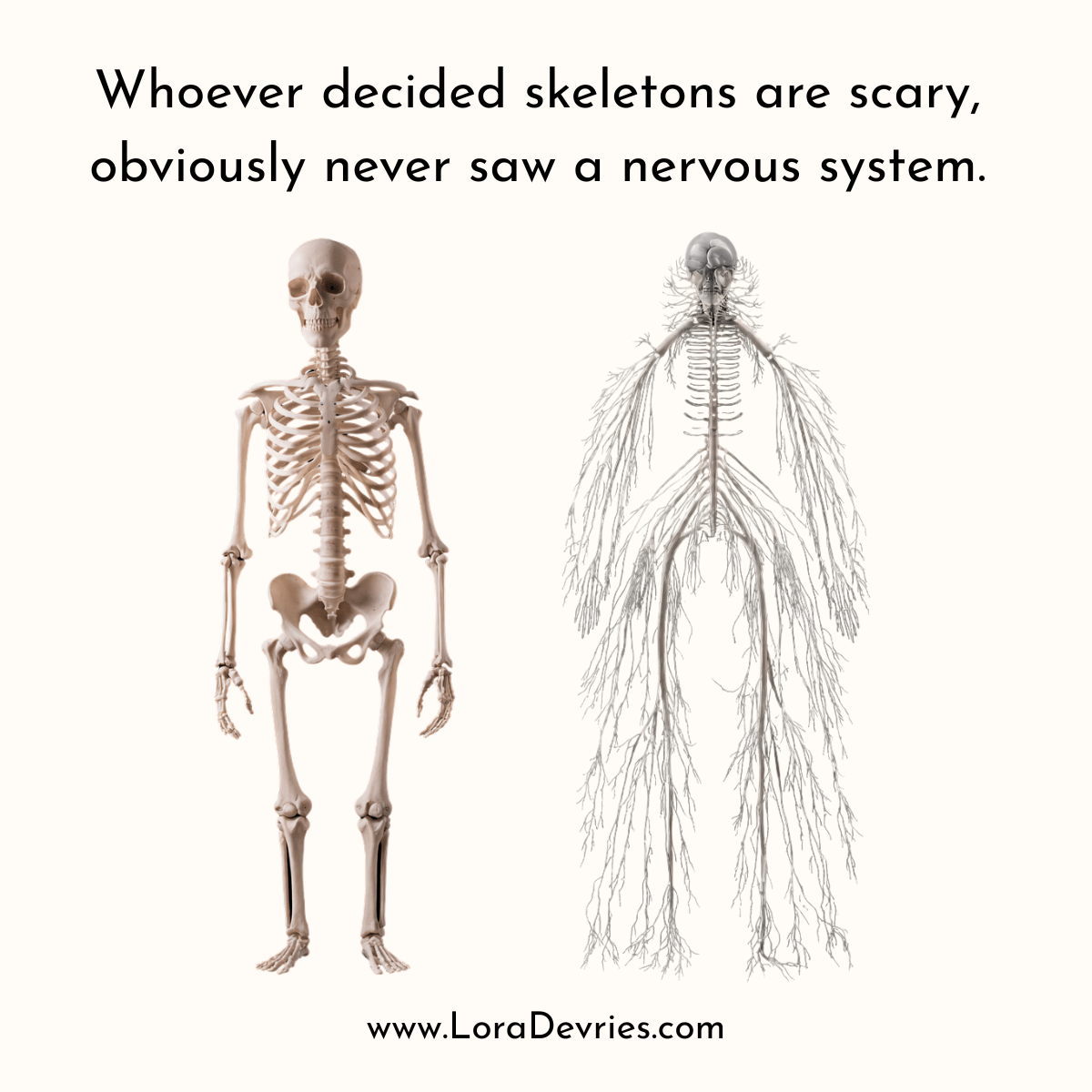
The Two Main Parts of the Nervous System
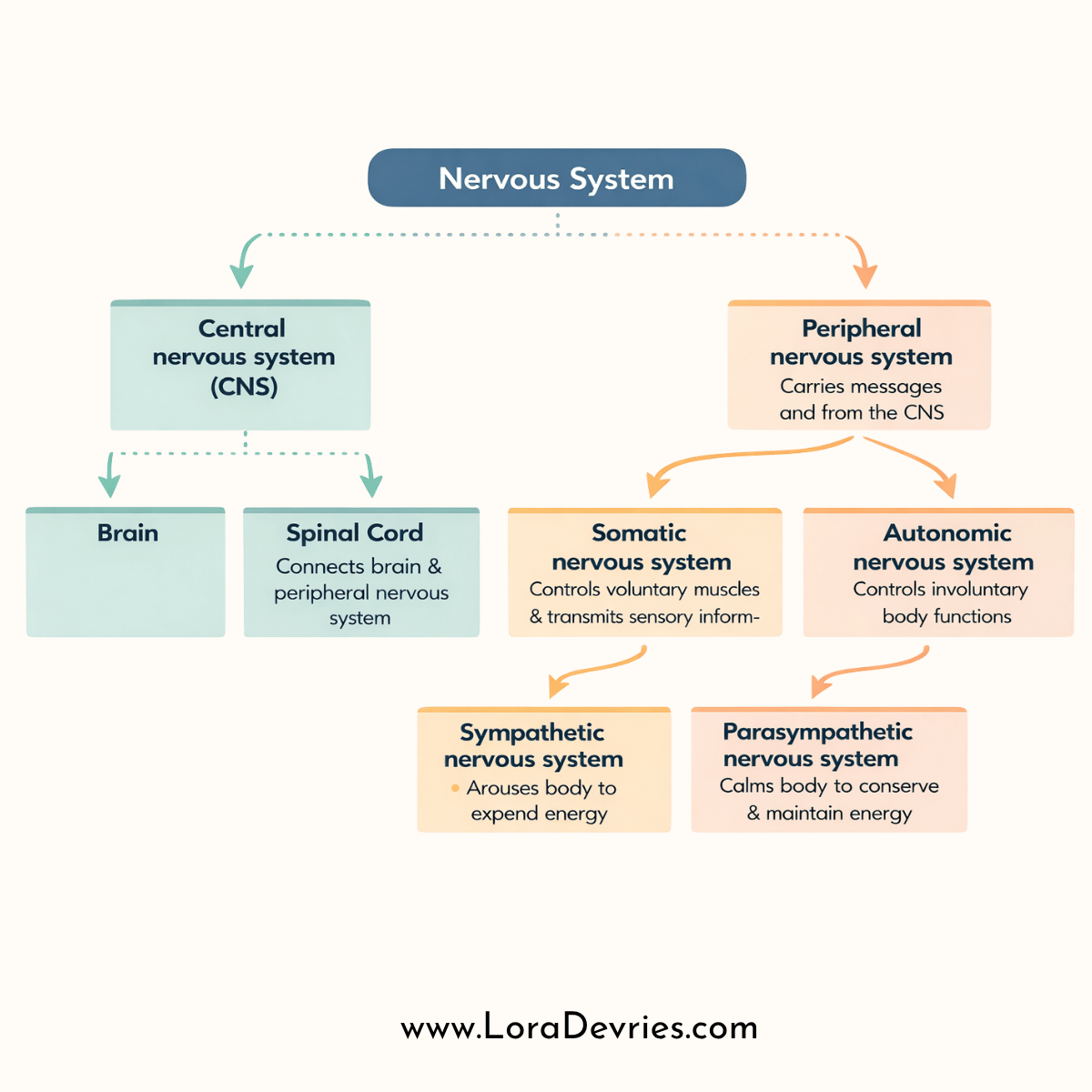
At a high level, the nervous system is divided into two main parts.
PART 1: Central Nervous System
The central nervous system includes the:
- brain
- spinal cord
This system acts as the body's central command center. The brain receives information from the body, processes it, and sends signals back through the spinal cord to coordinate responses.
Part 2: Peripheral Nervous System
The peripheral nervous system is the communication network that connects the rest of the body to the brain and spinal cord.
It includes the vast network of nerves that travel throughout the body, carrying signals between the brain and different organs, muscles, and tissues.
You can think of it like a communication highway that allows information to travel back and forth between the brain and the rest of the body.
Somatic vs Autonomic Nervous System
Within the peripheral nervous system, there are two important subsystems.
Somatic Nervous System
The somatic nervous system controls voluntary movements.
This includes actions such as:
- walking
- typing
- picking up a cup
These are movements we consciously decide to make.
Autonomic Nervous System
The autonomic nervous system, on the other hand, controls many of the body's automatic functions — the processes that happen without us needing to think about them.
These include things like:
- heart rate
- breathing
- digestion
- stress responses
The autonomic nervous system helps the body constantly adjust to internal and external conditions in order to maintain balance.
Within the autonomic nervous system, two additional systems play a key role in how the body responds to stress and recovery. These are known as the sympathetic and parasympathetic nervous systems. If this is all you remember - this is all you need to start better managing your stress in the moment and re-wiring your health.
Sympathetic vs Parasympathetic Nervous System
So if you forget everything I mentioned above THIS is the stuff you want to remember.
Remember, your nervous system is constantly scanning your environment.
It is asking one primary question:
Am I safe, or am I under threat?
Based on the answer, it either puts your body on high alert - stress mode - aka Sympathetic Nervous System or it puts your body in a more relaxed - peaceful mode - aka Parasympathetic System.
According to Poly Vagal Therapy and Somatic sciences these are the two major modes that constantly influence how much energy you have.
Our sympathetic system and our parasympathetic system.
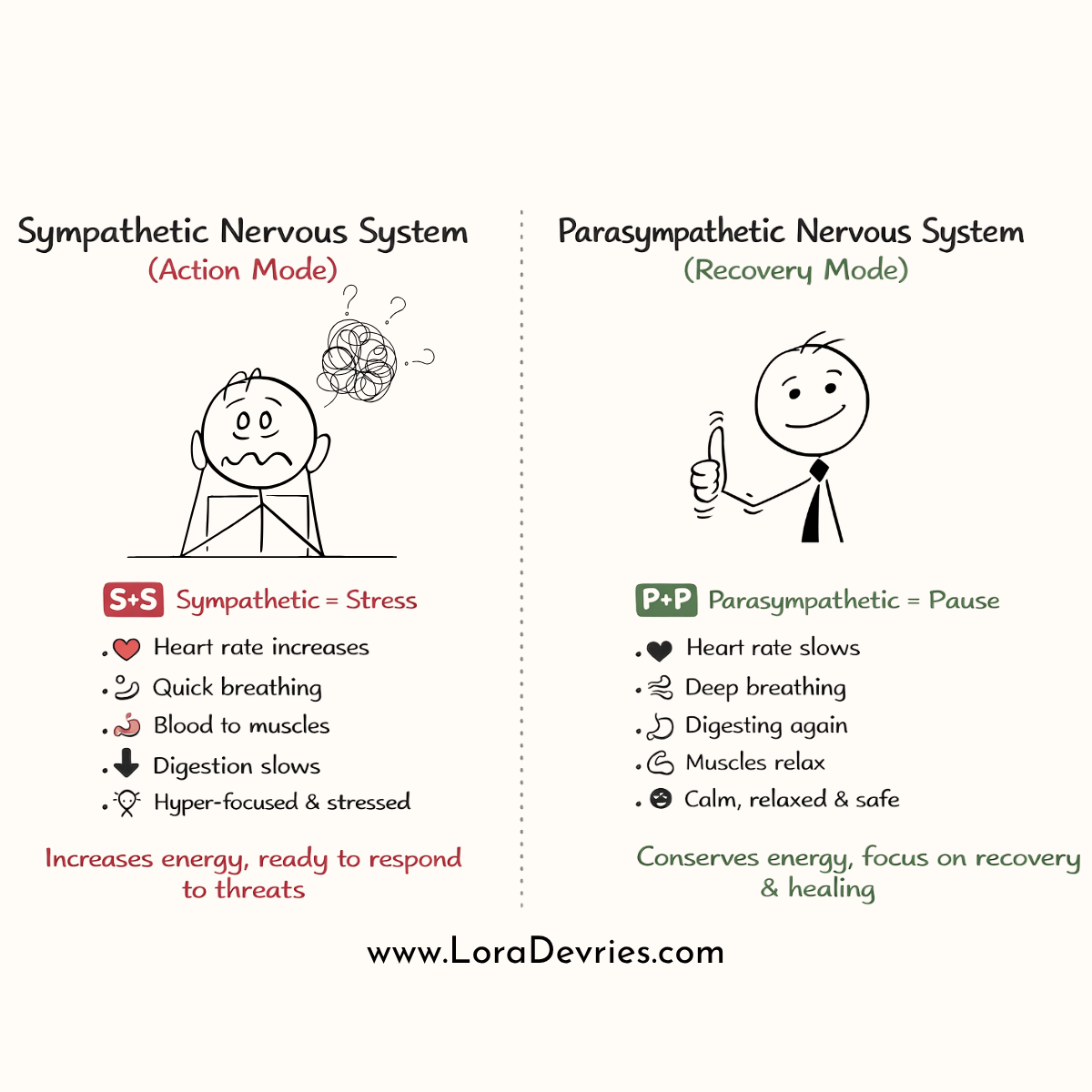
1. The Sympathetic Nervous System (Your action mode)
The Sympathetic Nervous System is often called the fight-or-flight response. Think of Sympathetic = Stress (S + S)
When it activates:
- Your heart rate increases
- Your breathing speeds up
- Blood moves toward muscles
- Digestion slows down
- Your brain becomes hyper-focused on threats
- You are ready to go into fight, flight or fawn mode.
This response is incredibly useful when dealing with real danger.
But in modern life, many people experience this activation all day long.
Not because they are physically unsafe, but because their brain is responding to constant cognitive and emotional demands.
We are living in a no-pause culture. With endless notifications, context switching, advertisements, social media, micro decisions, fake news, real news, political instability and just a constant digital overload.
Over time, the nervous system can begin to operate in a permanent state of activation.
This is when people start noticing symptoms like:
- racing thoughts
- irritability
- difficulty concentrating
- fatigue
- emotional reactivity
- trouble shutting off at night
When the sympathetic system stays active for long periods, the body burns energy quickly.
Chemically our bodies are responding by releasing Epinephrine (Adrenaline),Norepinephrine (Noradrenaline) and Cortisol.
That takes a toll on our bodies and changes our energy.
Over time, this contributes to mental fatigue, overwhelm, and burnout.
When I realized I was living CONSTANTLY in my sympathetic nervous system I realized that I had to take action to figure out how to change this, otherwise I was going to burnout.
Okay so now that you understand the sympathetic system (which is not bad… we just don’t want to LIVE there), let’s learn about the other side!
2. The Parasympathetic Nervous System (Your recovery mode)
The parasympathetic system does the opposite.
It slows things down so your body can repair, digest, and recharge. Think of the Parasympathetic as the ‘pause’ system (P & P)
When this system activates:
- your heart rate slows
- breathing becomes deeper
- digestion improves
- muscles relax
- the body conserves energy
This is often called the rest-and-digest state, and it’s where true recovery happens.
When we are able to get into our parasympathetic system our bodies begin to release Acetylcholine (ACh), Insulin, Oxytocin, Nitric Oxide and digestive enzymnes.
When our bodies release these chemicals we feel calm, grounded, safe, content and present. Our bodies and minds are able to take a moment to pause. To breathe.
Unfortunately, in today’s world, most people (myself included) struggle to live within our para-sympathetic systems. Without enough time in this state, the body struggles to restore the energy it burns during stress - leading to chronic stress and other significant mental and physical health problems.
What Is Nervous System Dysregulation?
Nervous system dysregulation occurs when the body remains stuck in a stress response for extended periods of time.
As mentioned above, most people in today's modern world - whether they realize it or not - are constantly in their Sympathetic system… which leads many of us to feel exhausted, burnout, irritated and not living the life we desire.
Symptoms:
- fatigue
- irritability
- brain fog
- emotional overwhelm
The catch 22 is that many of us may not have the ‘time’ to live in a parasympathetic state…Sure we all know we should get in nature, meditate, do yoga and focus on our health…there is a plethora of information that backs this up.
But unfortunately, the reality of family responsibilities and 9-5 jobs make that type of self care a luxury for most working professionals. And let’s be honest, in the moment, when we are about to lose our shit on our children, spouse or coworker…. Those strategies do not help.
The great news is that through my research I have learned that even taking micro-breaks a few times a day, re-wires your brain and nervous system for safety.
And over time, you can learn to recognize when your sympathetic (stress) system is in high gear and learn how to consciously switch it to your parasympathetic (pause) system.
The more you are able to do this via micro-check-ins throughout the day, the more you will re-wire your nervous system for safety and help in better managing your emotional health.
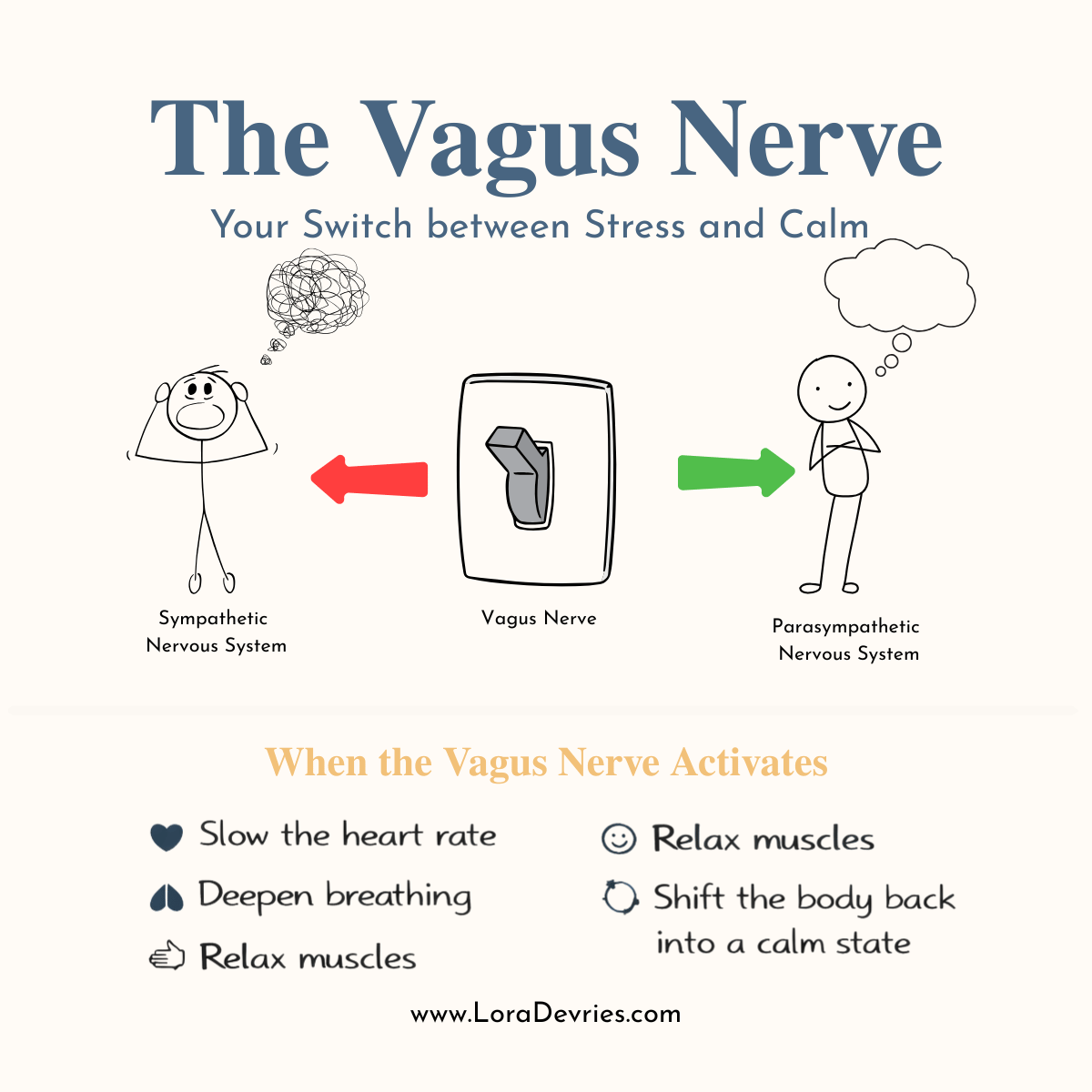
But how do you do this, you ask? This is where a special “switch” comes into place. Your Vagus Nerve.
Your Vagus Nerve: The Bridge Between Stress and Calm
Connecting the parasympathetic and sympathetic systems is one of the most important nerves in the body:
The vagus nerve.
The vagus nerve runs from the brain through the neck and into organs like the heart, lungs, and stomach. It acts like a communication highway between the brain and body.
Think of it as the switch that helps your body move from stress into recovery.
When the vagus nerve activates, it sends signals that help:
- slow the heart rate
- deepen breathing
- relax muscles
- shift the body back into a calm state
There are many practices like slow breathing, humming, cold plunge, sunlight exposure and laughter that can stimulate this nerve and help the body transition out of stress.
In addition there are multiple bio-hacking devices that stimulate the vagus nerve to help strengthen it so you can enhance your ability to move between your sympathetic and parasympathetic systems.
One biofeedback device I LOVE, is the HeartMath Inner Balance Coherence Plus Sensor. You can find my detailed review here!
Why Modern Life Drains Personal Energy
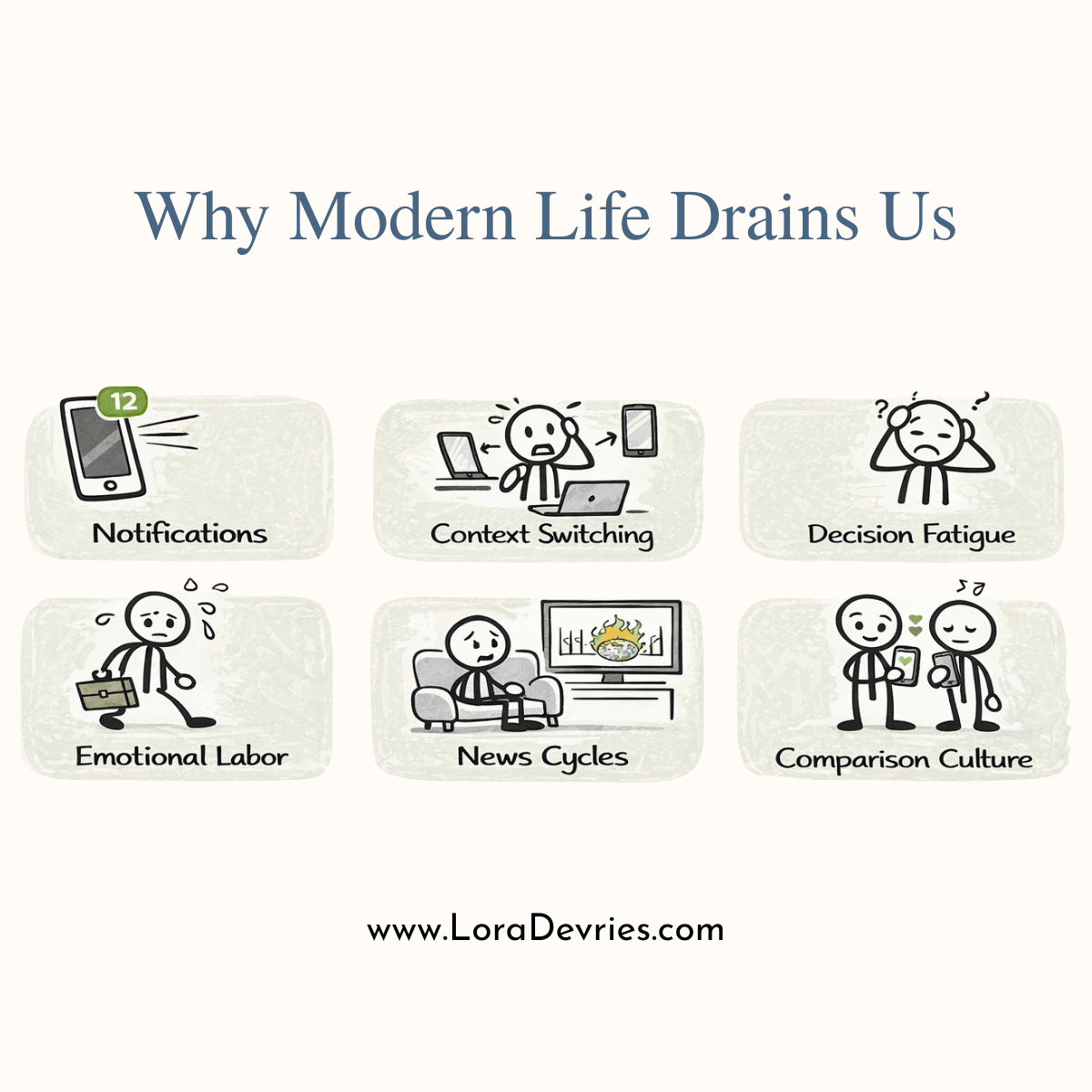
Modern life places constant demands on our attention, emotions, and nervous system.
Many work environments today are built around continuous input and rapid response — emails, meetings, notifications, decisions, and complex human interactions. While none of these demands are necessarily harmful on their own, the volume and frequency of them can create a state of ongoing stimulation for the body.
When this happens, we stay in our sympathetic nervous system. The one that keeps us on high alert.
In short bursts, this system is incredibly useful. It helps us respond quickly to challenges, solve problems, and stay alert.
However, when the sympathetic nervous system is activated too frequently without adequate recovery time, the body can begin to feel chronically “on edge.” Over time, this can contribute to fatigue, difficulty concentrating, irritability, and a general sense of mental and emotional exhaustion.
Part of the challenge that humans face, is that many of the demands of daily life are quietly activating our stress response without us even being aware!
These mico-stressors are just some of the causes:
- constant notifications and digital interruptions
- switching between tasks and conversations
- high volumes of decision-making
- being stuck in traffic
- emotionally demanding interactions
- ongoing exposure to stressful information and news cycles
Individually these experiences may seem small, but together they place continuous pressure on the systems that regulate mental focus, emotional stability, and physiological recovery.
Without moments of pause and regulation, the nervous system has fewer opportunities to shift into the parasympathetic state, where rest, recovery, and restoration occur.
This is one of the reasons so many people today describe feeling mentally overloaded and emotionally drained, even when they are not physically exhausted.
Learning to recognize and regulate these internal states is an important part of personal energy management.
Introducing Personal Energy Management
Once we begin to understand how mental energy, emotional energy, and the nervous system interact, a new question naturally arises:
How do we work with these systems more intentionally?
This is where the concept of Personal Energy Management comes in.
Personal Energy Management is the practice of understanding and regulating your internal state so you can think clearly, respond intentionally, and sustain well-being in demanding environments.
For many years, the dominant message in productivity culture was that people simply needed to manage their time better.
But time management alone does not address the deeper challenge many people face today — the constant strain placed on our attention, emotions, and nervous system.
Personal Energy Management shifts the focus inward.
Instead of only asking:
How should I organize my time?
We begin asking:
- What state is my mind and body in right now?
- What does my nervous system need in order to function well?
When people learn to recognize and regulate their internal state, they often experience greater clarity, emotional stability, and resilience in the face of everyday stress.
Over time, this awareness becomes a powerful tool for navigating both work and life with greater intention.
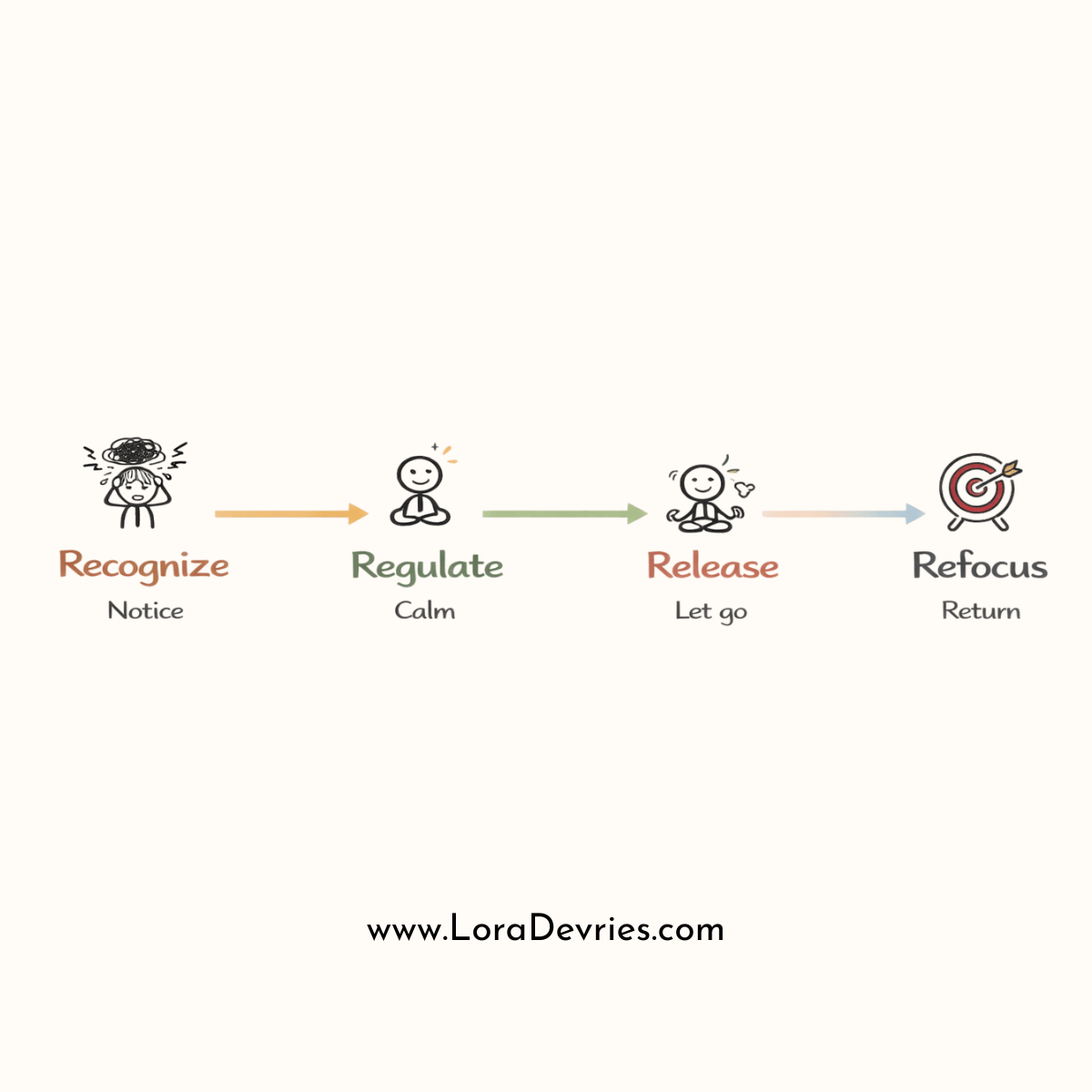
To help people effectively manage their internal state (in the moments we actually need it), I developed a simple framework known as the 4R Method.
The goal of this method is not to eliminate stress (which would be impossible), but rather to help people notice, regulate, and reset their internal state more intentionally.
The four steps are:
Step 1: Recognize
The first step is simply awareness.
Before we can shift our internal state, we need to notice what is happening inside our body and mind.
This might look like recognizing signs such as:
- racing thoughts
- emotional overwhelm
- physical tension
- difficulty concentrating
Many people move through their day without noticing these signals until they are already deeply depleted.
Learning to recognize these cues earlier is the foundation of energy management.
Step 2: Regulate
Once we notice our internal state, the next step is regulation.
This involves using simple tools that help calm or stabilize the nervous system.
Examples might include:
- slow breathing
- brief pauses between tasks
- grounding techniques
- stepping away from overstimulation
Research on nervous system regulation and breathwork shows that even small shifts in breathing and attention can influence the body’s stress response.
Step 3: Release
Stress and emotional load often accumulate in the body throughout the day.
The release stage involves allowing some of that built-up tension to move through the system.
This might include:
- movement or stretching
- shaking out physical tension
- journaling or emotional processing
- brief walks or moments of physical reset
These small actions help prevent stress from continuing to build beneath the surface.
Step 4: Refocus
After recognizing, regulating, and releasing tension, the final step is to intentionally return attention to what matters most.
This step helps restore clarity and direction.
Rather than continuing to operate from overwhelm or reactivity, people can re-engage with their work and relationships from a more grounded state.
Over time, practicing these small shifts can significantly improve how people navigate stress, decision-making, and emotional demands.
The Future of Personal Energy
Personal energy is not something you have.It is something your body is constantly generating, using, and responding to.
The pace and complexity of modern life show no signs of slowing down.
People are looking for ways to better manage their stress in the every day moments.
AI is changing our world at a rapid pace and humans are being asked to manage increasing levels of information and emotional labour.
At the same time, research on stress, burnout, and nervous system regulation continues to highlight how deeply our internal state influences our ability to function well.
In this context, the ability to understand and regulate our personal energy may become one of the most valuable skills of the coming decade.
Just as previous generations learned the importance of time management and productivity systems, the next wave of personal development may focus more on internal regulation, emotional awareness, and nervous system balance.
Learning to manage personal energy does not mean eliminating stress or achieving constant calm.
Rather, it means developing the awareness and tools needed to navigate life’s demands with greater clarity, resilience, and intention.
In a world that constantly pulls our attention outward, learning to understand and regulate your internal energy may become one of the most important skills you develop — not just for productivity, but for how you experience your life.
This article is intended for educational purposes only and is not a substitute for medical or psychological advice. If you are experiencing significant distress or health concerns, please consult a qualified healthcare professional.
Interested in learning more practical tips and strategies for your mental well being and personal development - check out these articles:
- HeartMath Inner Balance Biofeedback Device Review
- Intentional Living Guide
- Navigating Burnout: A Holistic Approach
- How to Make a Big Life Decision with Confidence
- 3 Reasons Why You Need Personal Energy in your Self Development Toolkit
- 16 epic Brené Brown quotes on strength and courage to Inspire You!
OR Check Out these FREE Resources Below:
Discover how to set intentions that actually work. Grab my FREE identity-based goal setting framework below.
Author